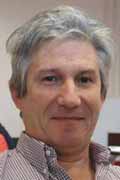
| Christian MARI | |
|
|
Francese, nato il 14 gennaio del 1945 in una cittadina a sud di Parigi, giocatore professionista di bridge, figlio di un partigiano corso, vive a Margés (Drôme) una cittadina a Sud di Lione, con la sua compagna di vita Dominique Frenove e non ha figli.
Laureatosi in Scienza delle Telecomunicazioni a 23 anni, ha cominciato a giocare a bridge un poco verso i 17 anni ma, non troppo, perché, a quel tempo, i suoi principali hobbies erano il calcio ed il tennis.
Insieme ad altri numerosi e prestigiosi piazzamenti che ne fanno uno dei più forti e longevi giocatori europei, Mari ha vinto gli Europei a Squadre del 1974 arrivando secondo nel 1973, 1989 e 1995 e terzo nel 1981, le Olimpiadi del 1980 e 1996, la Bermuda Bowl del 1997 preceduta dal bronzo del 1975, il Forbo Nation Cup del 1999, due volte il Biarritz Mixed (1998 e 1990), i Campionati del MEC del 1973 arrivando secondo nel 1977 e terzo nel 1996, il bronzo nella Rosenblum del 1978, l'oro nei Campionati Europei Misti a Squadre del 1992.
Mari, che è uno dei soli 11 World Grand Master francesi ancora in vita, passato nella Categoria Seniores ha vinto l'argento nel 2003 ed il bronzo nel 2001 nella Senior Bowl e nei Campionati Europei a Squadre ha collezionato un oro nel 2002 e tre bronzi (2001, 2004, 2006).

 French , born in 1945 in a small town south of Paris, a
professional bridge player, the son of a partisan course, lives in Margès (Drôme
), a small town south of Lyon, with his life partner Dominique Frenove and has
no children.
French , born in 1945 in a small town south of Paris, a
professional bridge player, the son of a partisan course, lives in Margès (Drôme
), a small town south of Lyon, with his life partner Dominique Frenove and has
no children.
He took a degree in Science of Telecommunications at age 23 and began to play bridge slightly to the age of 17, but not too much, because, at that time, his main hobbies were football and tennis.
Along with other numerous prestigious placements that make it one of the strongest and most enduring European players, Mari won the Europeans Teams in 1974, finishing second in 1973, 1989 and 1995 and third in 1981. He win the Olympics of 1980 and 1996, the Bermuda Bowl of 1997, preceded by the bronze in 1975 , the Forbo Nation Cup in 1999 , the Biarritz Mixed twice (1998 and 1990) , the MEC Championships in 1973 finishing second in 1977 and third in 1996. He also won the bronze in the 1978 Rosenblum and the gold in the European Mixed Teams Championships of 1992.
Mari, who is one of only 11 World Grand Master French still life, spent in Category Seniors, he won silver in 2003 and bronze in 2001 in the Senior Bowl and in the European Teams Championships has collected one gold and three bronze medals in 2002, 2001, 2004, 2006.
 Il n'est pas possible de
répondre à cette question dans cette discipline. La seule réponse objective peut
provenir du jugement émis par ses pairs à propos du talent de Christian Mari.
Il n'est pas possible de
répondre à cette question dans cette discipline. La seule réponse objective peut
provenir du jugement émis par ses pairs à propos du talent de Christian Mari.
Bref, ce monsieur sait jouer au bridge !
3 titres de champions du monde Open par équipes : une Bermuda Bowl en 1997 et
deux olympiades 1980 et 1996, plusieurs titres de champions d'Europe et depuis 3
ans, il convient d'ajouter à ce palmarès ses résultats dans la catégorie senior,
champion d'Europe en 2002 et vice-champion du monde cette année à Monaco.
Depuis les championnats d'Europe à Ostende
en 1973, voilà 30 ans que Christian Mari contribue au succès des équipes de
France.
Pourtant notre homme est infidèle, il a souvent changé de partenaire et joué en face des tous les meilleurs joueurs français mais jamais très longtemps : Michel Perron, Michel Lebel, Paul Chemla, Alain Lévy, Marc Bompis et en mixte avec Sylvie Willard et Véronique Bessis avec lesquelles il a gagné plusieurs grands festivals de bridge.
Il attribue cette instabilité à son caractère difficile et
exigeant mais aussi au fait qu'il ne soit pas possible en France de vivre du
bridge et, qu'alors, un champion doive trouver des partenaires qui lui assurent
des moyens d'existence.
Christian n'a jamais écrit de livre de
bridge et cependant son apport au système français est considérable. On lui doit
de remarquables études sur tous les développements après passe, qu'on devrait
légitimement appeler le "Mari" plutôt que le Drury, ce serait une juste
reconnaissance de son travail. On lui doit également des réflexions profondes
sur les contres négatifs qui furent, il y a 30 ans déjà, salués par le grand
Kaplan comme une avancée capitale dans les systèmes d'enchères compétitives.
Aujourd'hui, toujours aussi brillant, Christian Mari est un peu démotivé par le bridge, il serait dommage que cela dure à une heure où il approuve les efforts que la fédération semble prête à faire en faveur de ses champions.
| Precedente / Previous / Precedent | Successivo / Next / Prochain |